League 2: How do teams score the first goal?
Last time, I wrote about the importance of the first goal (here). We know how important the first goal is, so the next question is “How can we score it?” Therefore, we will look at how the league 2 teams score their first goals. If you search in the internet, it is not difficult to find some findings about the general goal statistics. However, most of the goals were scored in different backgrounds and situations. Only the first goals are scored under the same circumstances: 0 – 0. Therefore, I think it is meaningful to look at the first goal statistics because it reflects the ability of teams to break the 0 – 0 situation. Please note that all the data of goals and league positions were updated to 22/10/2012.
All First Goals
The following chart shows how the teams scored all their first goals:
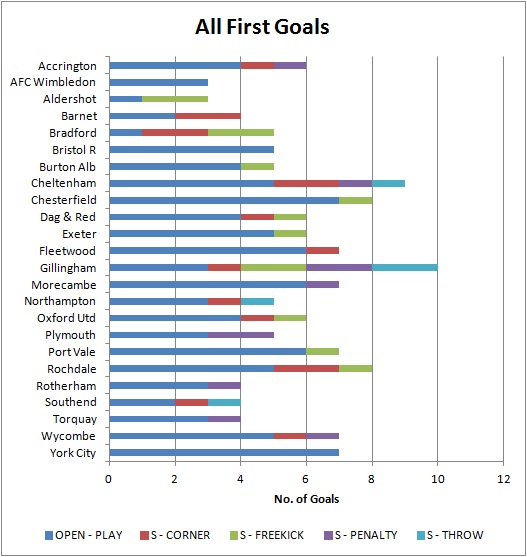
The goals were divided into five categories: open play, corner, free kick, penalty and throw-in. Here are the key findings:
- At least 50% of first goals were scored in open play in most teams except Aldershot, Bradford and Gillingham. Only 20% of first goals of Bradford were came from open play.
- Gillingham, which is leading the league, shows how strong they are in this chart. Not only they scored more first goals than the rest of the league, the more important point is they showed that they can score first goal in different ways (the only team which scored first goals in all five categories). They get both quantity and variety of first goals.
- Cheltenham is the second best. They scored 9 first goals in four categories.
- AFC Wimbledon, Bristol Rovers and York City scored all their first goals in open play. If you are play against them, it may be a good idea to be more aggressive in tackling to interrupt their open play because they are weak at scoring the first goal in set piece.
- If we look at the best 4 teams in this chart (Gillingham, Cheltenham, Chesterfield and Rochdale). Their league positions are 1st, 4th, 13th and 8th. I argue that strong at scoring first goal will bring teams to the top half of the table. However, it also depends on how good the team can retain their winning position. This topic was discussed last time.
Open Play First Goals
Then we focus on the open play goals first. The following chart shows how the teams scored the first goals in open play.

The goals were divided into four categories: right foot, left foot, header and other. Here are the key findings:
- Aldershot and Bradford are struggling in scoring open play first goal by scoring just once. However, it is worthy to note that Aldershot is in 23th and Bradford City is in 5th position.
- Barnet and Southend are the second worst by scoring 2 open play first goals. Barnet is in 24th and Southend is in 11th position. I argue that weak at scoring open play first goal will bring the teams to bottom zone but it is interesting to find out what Bradford and Southend did to bring them a decent league position.
- AFC Wimbledon and York City scored the most open play first goal by left foot.
- If we look at the best 5 teams in this chart (Chesterfield, York City, Fleetwood, Morecambe and Port Vale). Their positions are 13th, 12th, 3nd, 14th and 2nd). Only 2 out of 5 teams are in the first 7 positions which is playoff zone. I argue that strong at scoring open play first goal will bring the team to a mid table position at least but not enough to be the top 7 positions.
- Only 8 teams had scored open play first goals by header. 6 out of 8 teams are in the top half of the table. Gillingham and Fleetwood are the best and they are in the top 3 position in the league table. I argue that there is a relationship between them.
Set Piece First Goals
The following chart shows how the teams scored the first goals in set piece.
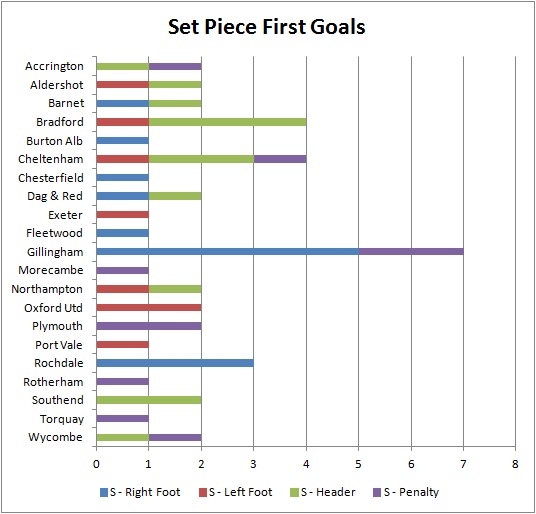
The goals were divided into four categories: right foot, left foot, header and penalty. Here are the key findings:
- Most of the teams scored 1 or 2 set piece first goal.
- Gillingham is overwhelming in this chart, performing much better than the rest of the league. Interestingly, there is no header and left foot goal within those 7 goals. Scoring set piece first goal is a strong weapon of Gillingham to be the leader of the league.
- Bradford is the strongest team in scoring by headers in set piece first goal.
- If we look at the best 4 teams in this chart (Gillingham, Bradford, Cheltenham and Rochdale). Their league positions are 1st, 5th, 4nd and 8nd). All of them are in top half of the table. 3 out of 4 teams are in the top 7 positions which is playoff zone. I argue that strong at scoring set piece first goal will bring the team to the top 7 positions.
Conclusions:
- At least 50% of first goals were scored in open play in most teams except Aldershot, Bradford and Gillingham
- Gillingham and Cheltenham can score first goals through different ways and they are the two best team of scoring first goal
- Strong at scoring first goal will bring teams to the top half of the table
- AFC Wimbledon and York City scored the most open play first goal by left foot
- Only 8 teams had scored open play first goals by header. 6 out of 8 teams are in the top half of the table
- Weak at scoring open play first goal will bring the teams to bottom zone. Aldershot and Barnet are the examples
- Most of the teams scored 1 or 2 set piece first goal
- Gillingham is overwhelming in scoring set piece first goal
- Bradford is the strongest team in scoring by headers in set piece first goal
- Strong at scoring set piece first goal will bring the team to the top 7 positions
Scoring first goal is not everything, it is also important to retain the winning position which was discussed in the last article (here).
Share this:

England League 2: How important is the first goal?
Performance analysis is usually thought as an elite tool which is for big clubs and high level leagues only because big clubs have the resources to afford analysis software and different IT technological support. In my opinion, it should not be the case. Performance analysis is a process which can be done by small football clubs also. Small clubs don’t have the big budget to do as much as the big clubs do but we are going through the same process. That’s why I would like to share my experience and work of doing performance analysis in a League 2 club.
No doubt, everybody knows the first goal is important. However, do they know how important it is? How to transfer the concept of “importance” to a quantified stuff, such as points? Different leagues have different levels; we can’t apply all the findings in Premier League to League 2 as there are so many differences such as playing styles, distance covered, etc. I would quantify the concept of “importance” by making statistics about the points got at the end of the game by a team when they scored or conceded the first goal. I would call it as “expected points” which means the points a team expected to get from the first goal. I would use different perspectives to analyse the first goal in league 2:
- Time of goal
- Match location (Home or Away)
- League position (In groups)
- Team
Average
I used the first 8 league games in each team, which means 95 games in total (the game between Wycombe and Bristol Rovers on 25/8 was excluded as it was abandoned 66 minutes). Among these 95 games, 86 games had goal(s). The following chart shows that the expected points of scoring first and conceding first are 2.30 and 0.49 in average. These would be used as a reference for other results found by using different perspectives.

Time of Goal
Time is an important factor of first goal. I divide 90 minutes into 6 categories, which mean 15 minutes per category.

Teams got most expected points (3 points) when they scored the first goal in 76-90 minutes. It is reasonable as there is not much time for the opponent to fight back. However, there were only 2 goals scored in this timeslot which makes this finding not so persuasive since the sample size is not big enough. I’d rather to ignore this timeslot. Teams could get high expected points if they score the first goal between 16 to 45 minutes, 30 minutes timeslot before the interval. Since the expected points drops after 45 minutes, the first goal scored within 30 minutes before half time are more valuable than first goal scored 30 minutes after half time. I heard argument that scoring before the interval is a great advantage but statistics in this chart showing that the expected points from 16-30 minutes and 31-45 minutes are similar. However, a similar argument may be right. Scoring before the interval is particularly damaging to the opposition. As you can see from the chart, teams conceding first goal just before half time could only get 0.29 expected points which is obviously less than conceding first goal in other timeslots which fits the argument. Nobody would like to concede an early goal but statistics show that the team don’t have to be pessimistic even they do concede an early goal within 1-15 minutes. Teams can get 0.64 expected points which is the highest comparing with other timeslots. This can be explained that the team still have much time to bounce back.
Location

From the above chart, teams scoring the first goal in home were more likely to keep the winning positions and get more points than scoring first in away game. It may be explained by home advantage that teams play better in home. However, the same argument can’t be applied in conceding first because they both got 0.49 expected points. Home advantage may help the team more to keep winning position but not bouncing back from behind.
League Position

Note that the league positions are updated to 1/10. In scoring first (blue columns), an obvious downward trend can be seen which shows that stronger teams were more likely to retain their winning position when scoring first. There is a big gap difference (0.51 expected points) between positions 1-6 and positions 7-12. Another big gap difference (0.49 expected points) appears in between positions 7-12 and positions 13-18. However, there is not much difference (0.11 expected points) between positions 13-18 and positions 19-24. I would say in terms of the ability to retain winning position after scoring first, there are 3 levels in league 2. Positions 13-24 would be at more or less the same level. Positions 7-12 are much better than the bottom half of the table but positions 1-6 are much better than positions 7-12 as well.
The downward trend can’t be seen in considering the conceding first (red columns). Positions 13-18 got a better result than positions 7-12, similar to positions 1-6. In fact, it surprises me a little bit as I expected the downward trend in conceding first same as scoring first. We would look at individual teams afterwards to see what we can find. However, the expected points from positions 19-24 (0.16 points) are obviously less than other groups. It shows that they struggle to bounce back if they concede the first goal.
Team

The tables are listed according to the league position (updated to 1/10). The above table is about scoring first. The first 8 teams in the league table all scored first goals for at least 4 times. Among these 8 teams, 4 of them get expected points of 3 which means that whey they scored first, they kept the winning position and won the game every time. Gillingham scored first goal in 7 out of 8 games which is a brilliant result. Moreover, they retained and won all those 7 games which make them the best in league 2. Rochdale performed very well since they scored first goal 6 times, which is the second best. However, their weakness is to retain the winning position because they can only get 1.8 expected points, which is the worst in the top half of the table. Plymouth scored first goal twice but they get only 0.5 expected points per game which means they couldn’t won a game even they scored first. This result is the worst in the league. We would look at the conceding first in the following table.

Although Plymouth is the worst team in retaining winning position, they are the strongest team in the league 2 to bounce back from conceding first. They conceded first goal four times, but they bounced back and won the game twice so they got 1.5 expected points per game, which is 50% better than a draw. This is the best result in the league 2. Exeter and Torquay are the second best teams, getting 1.3 expected points. It is worthy to note that Torquay and Plymouth are at the 15th and 16th of the table, but they are the two best team to bounce back from conceding first. This can explain why in the league position chart positions 13-18 performs surprisingly better than expected.
Conclusion:
- Scoring in 16-30, 31-45 minutes (30 minutes before half time) can get higher expected points
- Conceding 15 minutes before half time would be the worst time to concede the first goal
- Playing in home is more likely to retain the winning position
- In terms of bouncing back, there is no difference in playing home and away games
- The 12 teams in the top half of league table are much better in retaining winning position than the bottom half of the table. Among those 12 teams in the top half of table, the first 6 teams are significantly better than positions 7-12 teams.
- Positions 19-24 teams are obviously weak in bouncing back when conceding first
- Gillingham is the strongest team to score first and retain the winning position
- Rochdale is strong in scoring first but weak at retaining the winning position to the end of the game
- Plymouth is a special team. They are the worst team in scoring first and get only 0.5 expected points. However, they are the strongest team in bouncing back from conceding first, getting 1.5 expected points.
This is my first analysis article about league 2. I will write at least a few more articles about league 2 this season.
Share this:

Motion Analysis in Football
Nowadays, many coaches start using notational analysis by pen and paper to help their coaching. For example, they count the number of passes, shots and crosses etc to see how the team performed and which area can be improved. Apart from notational analysis, the coaches can improve their coaching by knowing more about motion analysis in football as well. In my previous article (here), I discussed about what motion analysis is. In short, motion analysis is the process of classifying activities according to intensity of movements (Strudwick and Reilly 2001). The three elements that should be considered are intensity (or quality), duration (or distance) and frequency (Carling et al 2005). The activities were coded according to intensity of movement, e.g. walking, jogging, cruising and sprinting. By using the information, the coaches can design specific drills to fit the football players in different levels and positions in order to achieve higher efficiency of improving performance.
Work rate activity profiles
One of the early researches about motion analysis in football was from Reilly and Thomas (1976). They found that the overall distance covered by outfield player during a match consists of 24% walking, 36% jogging, 20% cruising, 11% sprinting, 7% moving backwards and 2% moving in possession of the ball. The below figure visualises the above finding.
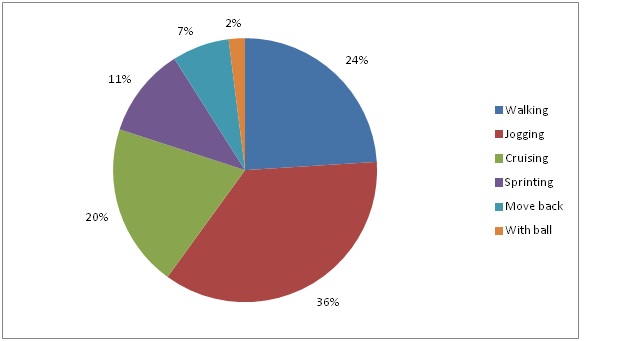
Figure 1 Relative distances covered in different categories of activity for outfield players during soccer match-play
They found two things about the ratio of low-high intensity exercise. The ratio is 2.2 to 1 in terms of distance covered and 7 to 1 in terms of time. Different researchers have different activity profiles. For example, Bradley et al (2009) classified players’ activities into standing, walking, jogging, running, high-speed running and sprinting. Generally, the activities would be classified into two categories: low to moderate intensity activity and high intensity activity and different researches had similar results. Bradley et al (2009) found that low-intensity activity represented 85.4% of total time. Bloomfield et al (2007) had a similar finding that 80-90% of performance is spent in low to moderate intensity activity whereas the remaining 10-20% are high intensity activities. From the above figure, you may realize that only 2% of the total distance covered by top players is with the ball, that means vast majority of actions are “off the ball”, for instance, running into space, support teammates, tracking opposing players. If you are a coach, try to ask yourself “Should I put more effort and time coaching players without the ball rather than just coaching the player with the ball?”. Some other findings such as player has a short rest pause of only 3s every 2 minutes and players generally have to run with effort (cruise or sprint) every 30s (Reilly and Williams 2003) may be useful for the coaches as well.
For the mean distance covered, Strudwick and Reilly (2001) stated that the top division players in the 1970s covered a mean distance of 8680m. In contemporary premier league the figure became 11264m. They suggested that it was because there are more passes, runs with the ball, dribbles and crosses which lead to the increase in the tempo of games. In the research of Bradley et al (2009), the result is 10714m. If you are a coach of adult’s team, the information can be a benchmark for your reference about distance covered for your players.
Does work rate and movement vary by the different positional roles?
Some coaches may realize there should be some differences but they may not realize what the differences are. There are positional differences in work rate and fitness levels. In terms of distance covered, midfield players have the greatest distance covered which is reasonable because they acts as links between defence and attack (Reilly and Thomas 1976)(Ekblom 1986)(Bangsbo et al 1991). This finding was supported by other research. For example, midfielders were engaged in a significantly less amount of time standing still and shuffling and the most time running and sprinting (Bloomfield et al 2007). Greatest distance covered sprinting were found in strikers and midfield players (Reilly and Williams 2003). In terms of the difference between full backs and centre backs, full backs covered more overall distance than the centre backs, but less distance sprinting (Strudwick and Reilly 2001)(Reilly and Williams 2003).
Apart from work rate, motion analysis analyse movement as well. There are different movement characteristics for different positions. Here is the list of findings from different researchers.
Defenders:
- Perform the highest amount of jogging, skipping and shuffling movements and spend a significantly less amount of time sprinting and running than the other positions (Bloomfield et al 2007)
- More body strength in order to compete with the strikers
- Highest amount of backwards and lateral movements (Rienze et al 2000)
- More turns of 0-90 degree(Bloomfield et al 2007)
- Ability to move backwards and sideways is important for defenders (Carling et al 2005)
- To be heavier and with higher BMI, although only slightly taller, than midfielders (Bloomfield et al 2005)
Midfielders
- Were engaged in a significantly less amount of time standing still and shuffling and the most time running and sprinting (Bloomfield et al 2007)
- Perform the most directly forward movements (Rienze et al 2000)
- More diagonal and arc movements (Bloomfield et al 2007)
- More turns of 270-360 degree (Bloomfield et al 2007)
Strikers/Forwards:
- Perform the most of the other types movements (jumping, landing, diving, sliding slowing downing, falling and getting up)
- Perform the most physical contact at high intensity,
- More stopping, these activities produce shearing forces on the lower limbs and Besier et al (2001) suggested that strength training and prehabilitation practices must be adopted and emphasised.
- More diagonal and arc movements (Bloomfield et al 2007)
- More turns of 270-360 degree (Bloomfield et al 2007)
- Forwards tend to receive the ball when sprinting (Carling et al 2005)
- To be heavier and with higher BMI, although only slightly taller, than midfielders (Bloomfield et al 2005)
I hope these are useful for the coaches to know more about different requirements in different positions in terms of work rate, movement and even body strength.
Does work rate vary by the styles of play?
Although all the work rate research done by different researchers are facts, we should think about whether it is ‘all of the facts’. Are they always 100% right and can be applied to all situations? I think style of play is a factor which can affect the work rate of a team. Some researchers had the same view also (Bradley et al 2009)(Reilly and Williams 2003). In possession play, the pace of the game is slowed down, the attacking moves are delayed and the players will wait until opportunities rises. In direct play, the team tries to raise the pace of the game by passing the ball quickly in order to transfer the ball quickly from defence to attack to create opportunities. Therefore, the team would prefer long passes rather than a sequence of short passes. Apart from possession play and direct play which are the most discussed styles of play, we shouldn’t ignore Total football and South American style. I don’t know much about these two styles but I think the work rate requirement of Total football would be similar to direct play as they exchanges positions frequently. South American style is more rhythmic and the overall distance covered is 1.5km less than in the English Premier League (Rienze et al 2000).
Summary
In the 90-minute match time, 80-90% of performance is spent in low to moderate intensity activity whereas the remaining 10-20% are high intensity activities. However, we must remember that most of the key incidents of the game are happened within those 10-20% high intensity activities. There are significant differences existing between strikers, midfield players and defenders in terms of work rate, activity profiles and movements. For example, defenders have the most of backwards and lateral movements. Midfielders covered the greatest distance. Strikers/ forwards tend to receive the ball when sprinting. I hope this article would be useful for the coaches to know more about different requirements of different positions in order to design more specific conditioning programs for the players. Defenders and strikers need speed and agility type drills while midfielders need interval running over longer distances.
References
BANGSBO, J., L. NORREGAARD and F. THORSO, 1991. Activity profile of professional soccer. Canadian Journal of Sports Science, 16, 110-16
BESIER, T.F., D.G. LLOYD, J.L. COCHRANE and T.R. ACKLAND, 2001. External loading of the knee joint during running and cutting manoeuvres. Medicine and Science in Sport and Exercise, 33, 1168-1175
BLOOMFIELD, J., R.C.J. POLMAN, R. BUTTERLY and P.G. O’DONOGHUE, 2005. An analysis of quality and body composition of four European soccer leagues. Journal of Sports Medicine and Physical Fitness, 45, 58-67
BLOOMFIELD, J., R. POLMAN and P. O’DONOGHUE, 2007. Physical demands of different positions in FA Premier League Soccer. Journal of Sports Science and Medicine, 6, 63-70
BRADLEY, P.S., W. SHELDON, B. WOOSTER, P.OLSEN, P.BOANAS and P. KRUSTRUP, 2009. High-intensity running in English FA Premier League soccer matches. Journal of Sports Sciences, 27(2), 159-168
CARLING, C. et al., 2005. Handbook of Soccer Match Analysis. Oxon: Routledge
EKBLOM, B., 1986. Applied physiology of soccer. Sports Medicine, 3, 50-60
REILLY, T. and A., M. WILLIAMS, 2003. Science and Soccer. 2nd ed. Oxon: Routledge
REILLY, T. and V. THOMAS, 1976. A motion analysis of work-rate in different positional roles in professional football match-play. Journal of Human Movement Studies, 2, 87-97
RIENZE, E., B. DRUST, T. REILLY, J.E.L. CARTER and A. MARTIN, 2000. Investigation of anthropometric and work-rate profiles of elite South American international players. Journal of Sports Medicine and Physical Fitness, 40, 162-9
STRUDWICK, T. and T. REILLY, 2001. Work-rate Profiles of Elite Premier League Football Players. Journal of Exercise Science, 4(2)
Share this:

What are Performance Analysis and Match Analysis?
Fifteen years ago, there may be only a few big Premier League football clubs had a performance analysis department. Nowadays, even a League 2 club like Aldershot for which I am working have set up a Performance Analysis department this season. It is a fast growing industry and I firmly believe it will keep growing for the next ten years at least.
Where does it come from?
If we want to know where it came from, sports science has to be mentioned. The first academic programmes in sports science were studied in the UK in 1975. Initially, it included biology, biochemistry, physiology, biomechanics, mathematics, psychology and sociology. Nowadays, the sports science programmes may include economics, recreation sport development, coaching and computer science also (Reilly and Williams 2003). The first Bachelor of Science degree which combined science and football together was offered at Liverpool John Moores University in 1997. Performance analysis in football was one of the core modules.
Difference between Performance Analysis and Match Analysis
You may realize both terms are used in books and articles as they are very similar. In my opinion, match analysis focuses everything about the matches, e.g. post-match analysis, opposition analysis (tactics and strategies). Performance analysis has a wider coverage and includes more disciplines. In short, match analysis is part of the performance analysis. Apart from match analysis, performance analysis includes player recruitment, player evaluation, training analysis, trend analysis and even referees analysis (Prozone 2009). However, you may realize that some of these disciplines are just the further development of match analysis, e.g. player evaluation and trend analysis. Therefore, I think match analysis is the core part of performance analysis. I will focuses on match analysis in the following paragraphs.
Why match analysis is undertaken?
Some people may argue that soccer is an art, especially if you watch the Zinadine Zidane played. I won’t deny that as I agree playing and coaching soccer are arts but I think science can be a part of soccer as well. In terms of preparation, science information is helpful for coaches and trainers to make decisions and judgement. For one’s own team, the information can be used to identify strengths and weaknesses. For opposition, we can use data to counter opposing strengths and exploit weaknesses. Moreover, match analysis can be used to evaluate whether the training programmes improve the match performance or not (Carling et al. 2005). The information is a big set of data and coach can’t remember all of it during the game. Franks and Miller (1986) found that international level soccer coaches could only recollect 30% of the key elements that determined successful soccer performance observed. Another research indicated that coaches are able to recall fewer than half of the key incidents (Carling et al. 2005). Another reason is that the coach may not be able to get the information objectively. Neisser (1982) found that the accuracy of memories of events I greatly influenced by many factors, e.g. the beliefs of the observer. In other words, coaches are active observers rather than passive perceivers of information. Their perception of events would not be a copying process but rather a selective and constructive one (Reilly 1996). Then coaches can’t provide an objective and unbiased information. Therefore, match analysis/ performance analysis is needed to provide such information and analysis.
What does match analysis include?
In my opinion, match analysis can be divided into two categories: Notational analysis and Motion analysis.
Notational analysis is a means of recording events so that there is an accurate and objective record of what actually took place (Carling et al. 2005). There should be at least five elements which should be recorded: the position (where?), the players involved (who?), the action concerned (what?), the time (when?) and the outcome of the activity (e.g. successful or unsuccessful, or on target or off target. Generally there are two ways to do it: by hand/manual or by computer. Reep and Benjamin (1968) were the early researchers in hand notation system. They collected data from 3213 matches between 1953 and 1968 and recorded actions such as passing and shooting. Their conclusions were that 80% of goals were resulted from a sequence of three passes or less and 50% of all goals came from possession gained in the final attacking quarter of the pitch. In terms of computerized notation system, Matchviewer of Prozone is a good example which provides the data of passing, heading, shooting, tackling etc. Both systems have their strengths and weaknesses. The following table summarizes part of it.
| Hand/ Manual notational system | Computerized notational system | |
| Strength |
|
|
| Weakness |
|
|
Table 1: Summary of the strengths and weaknesses of hand and computerized notation system
Another category of match analysis is motion analysis which focuses on raw features of an individual’s activity and movement (Carling et al. 2005). It can specify work rates of the players in different positions and distances covered in a game (Reilly and Williams 2003). This analysis is useful in identifying fatigue and differentiating between positional differences in work rate and fitness levels (e.g. ability to move backwards and sideways is important for defenders) (Carling et al. 2005). There are three elements which should be measured: intensity (walking, jogging, cruising and sprinting), duration (or distance) and frequency. Prozone3 is software of Prozone which provides this sort of data. Nowadays, most of the motion analysis would be done by computer as it is difficult for people to record how many metres a player ran in a match. However, in the old days, researchers had to do it by hand. Reilly and Thomas (1976) recorded and analyzed the intensity and extent of discrete activities. They combined hand notation with tape to analyse the movement of the players. They found that a player is in possession of the ball for less than 2% of the game.
Conclusion
Performance analysis is becoming more popular in lower leagues and more football clubs will set up the performance analysis department in future. There is still much room for the development of performance analysis. Match analysis is different from performance analysis but it is the core part of performance analysis. The aim of doing analysis is to provide objective information and analysis for the coach about past performance (either team or individual). The analysis can be done by hand/manual and computer as well. Both systems have their own strengths and weaknesses.
References
CARLING, C. et al., 2005. Handbook of Soccer Match Analysis. Oxon: Routledge
FRANKS, I.M. and MILLER, G., 1986. Eyewitness testimony in sport. Journal of Sport Behavior, 9, 38-45
NEISSER, U., 1982. Memory Observed. San Francisco: CA
PROZONE, 2009. Services [online][viewed 5 September 2012]. Available from: http://www.prozonesports.com/services.html
REEP, C., & BENJAMIN, B., 1968. Skill and chance in association football. Journal of the Royal Statistical Society A, 131, 581-585
REILLY, T., 1996. Science and Soccer. E & FN Spon
REILLY, T. and THOMAS, V., 1976. A motion analysis of work-rate in different positional roles in professional football match-play. Journal of Human Movement Studies, 2, 87-97
REILLY, T. and A., M. WILLIAMS, 2003. Science and Soccer. 2nd ed. Oxon: Routledge


 Football Performance Analysis